Nov 20, 2025
Alison Coffey
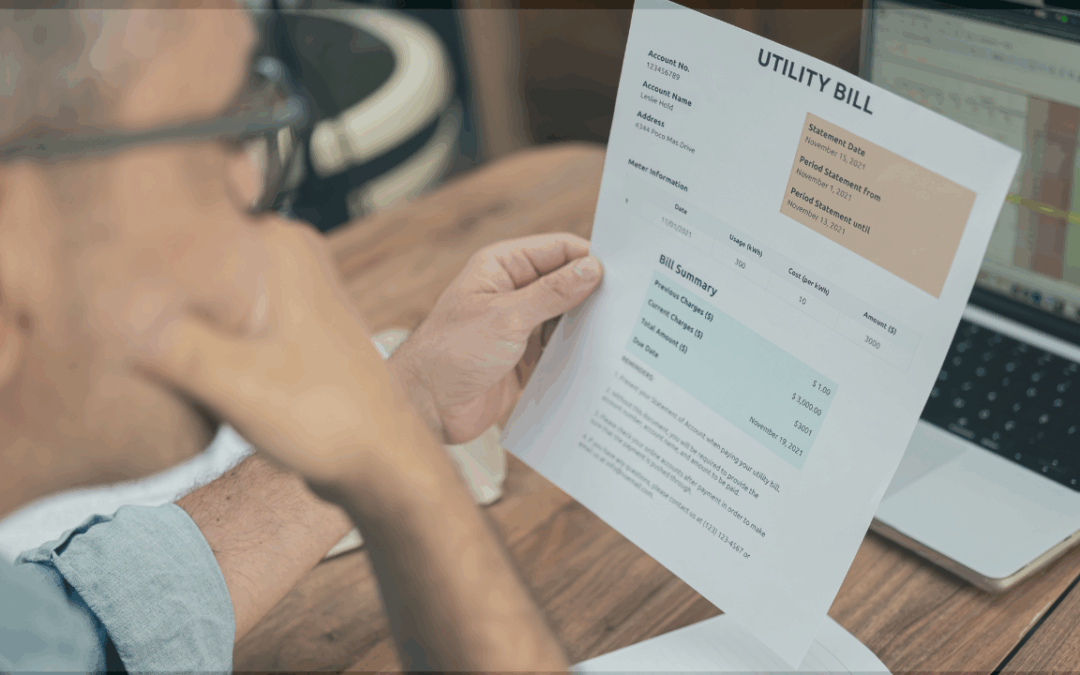
Across much of the country, households are feeling the strain of rising energy costs. As electricity rates go up, close to 40% of households are struggling to pay for basic household expenses, and nearly 1 in 4 report being unable to pay a utility bill in the past year. This places millions at risk of having their energy shut off due to an inability to afford their bills.
The issue of affordability was front and center in the 2025 election season, indicating that household energy costs are also becoming a salient political issue for voters. While Zohran Mamdani’s broad affordability message resonated in the New York City mayoral race, energy affordability in particular was prominent in this year’s statewide races. New Jersey’s governor-elect Mikie Sherrill has promised to declare a “State of Emergency on Utility Costs” and to freeze rates on her first day in office, and Virginia’s winner, Abigail Spanberger campaigned with her Affordable Virginia Plan, which includes a significant focus on reigning in electricity costs.
In Georgia, the election of two democratic commissioners to the state’s republican-held Public Service Commission, the entity that regulates investor-owned utilities, is perhaps the most pointed indication that household energy costs are becoming a major concern for voters. It was an off-year election and typically, few voters are familiar with utility regulatory bodies. Yet, the candidates, who campaigned against rising utility prices and corporate greed, were elected by the biggest margins the democratic party has seen in a statewide election in Georgia in over 20 years, and it was the first time challengers in Georgia unseated incumbent commissioners in nearly two decades.
These outcomes highlight important currents in today’s political landscape: the deepening economic struggles of households across the country, the emergence of household energy costs as an issue of broad concern, and growing frustrations with the concentration of corporate wealth. They also point to an urgent need for innovative policy and regulatory solutions that can integrate clean energy and support upgrades to our aging power grid while keeping utility costs affordable for everyday people.
Paying higher bills, getting left in the dark
Over the last several years, rising electricity bills have been deepening economic hardship for households across the country. Today, residential customers are paying on average nearly 30% more for their electric bills than they were in 2019, with rate increases outpacing inflation and creating a higher energy burden for low income households. The State of California saw the largest increase during this period: a striking 66% average jump in electricity costs. Households in countless other states, from Connecticut to Texas to Hawaii, are struggling with high bills as well.
In many states, customers are experiencing back-to-back rate hikes multiple years in a row, and in some cases, rates going up multiple times a year. These trends appear poised to continue. During the first three quarters of 2025, utility-requested rate increases reached a record high of $34 billion, which is more than double the amount requested during the same period in 2024. As a result, 124 million customers are expected to see higher bills.
At the same time that rates are going up, many energy customers must also cope with unreliable electric service. As our grid infrastructure ages, climate change makes extreme weather more frequent and severe, and the rapid growth of AI data centers places significant demands on the grid, communities across the country face greater risk of prolonged outages.
These trends are affecting customers across geographies and demographics, but low-income households and communities of color experience disproportionate impacts. Black, Hispanic and Indigenous households pay higher portions of their income on energy than white households, even when controlling for income, and Black-headed households experience higher shut-off rates when they fall behind on their utility bills. In many formerly redlined and tribal communities, racialized disinvestment in grid infrastructure makes residents more vulnerable to outages, and communities of color often endure longer waits before service is restored.
Meanwhile, investor-owned utilities (IOUs) are bringing in record profits. In 2024, the ten highest paid corporate utility CEOs each received compensation between $13 and $21 million annually, with many receiving multi-million dollar raises from the previous year. Cumulatively, the CEOs of 54 major utilities made over $530 million. All while everyday people are being left in the dark.
Building momentum towards affordable electricity and utility accountability
There is growing momentum to demand affordable energy and keep utilities accountable not only to their shareholders, but to the customers they serve. Across the country we’re seeing state-based efforts to fight rate hikes as well as new national coalitions aligning to take on the utilities that are putting profits above people.
Progress on this front will require channeling people’s frustrations with the rising cost of living and corporate greed into effective mobilization. Efforts led by groups like Georgia Conservation Voters to educate and mobilize ratepayers around their state’s Public Service Commission elections demonstrate one important avenue toward utility accountability.
Importantly, it will also require innovative policy solutions and accountability mechanisms that can make our grid more resilient and reliable, while keeping rates affordable for residential energy users. Utilities often justify repeated rate increases as the necessary means to pay for grid upgrades. In California, for example, the costs of hardening the grid to wildfire are being passed along to customers, contributing to steep rate hikes.
As skyrocketing rates create significant hardship for customers across the country, solutions that increase reliability while keeping rates affordable for residential customers are urgently needed.
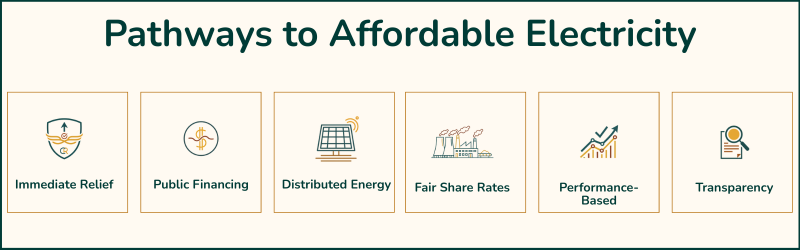
While the most promising solutions may look different across different state and utility contexts, they can include:
- Programs that provide near-term relief from high energy bills and energy insecurity
As energy bills skyrocket, protecting energy-insecure households requires the expansion of public and utility-based programs that can deliver immediate relief. Programs that deliver whole-home repairs, weatherization, energy efficiency investments are crucial for helping low- and moderate-income households conserve energy and keep bills lower. Increasing funding for direct bill assistance programs at the federal, state, and utility levels is urgently needed to support households who must decide whether to ‘heat or eat’. And because utility disconnections are financially and emotionally devastating, states can also protect households by placing moratoria on utility shut-offs due to non-payment, as many did during the COVID-19 pandemic, and as Oregon recently did in response to the government shutdown. Alongside these short-term measures, structural changes to our utility and energy systems are also needed. - Public financing models that fund infrastructure improvements while keeping rates down
Investor-owned utilities make a profit from their capital investments, rather than electricity sales. In order to generate a return on investment for shareholders, IOUs are incentivized to build out new poles and wires, and the costs of these capital investments are then passed onto customers with electric rates increases. Public financing for grid upgrades offers one potential route to lower the costs for grid improvements being passed onto ratepayers. New legislation in California, for example, would require the state’s investor-owned utilities to accept public financing for infrastructure investments, allowing for badly needed wildfire hardening investments at a lower cost for customers. - Distributed energy resources and planning that reduce customer bills, utility costs, and increase resilience during extreme weather
Solar power has become the least expensive and fastest to deploy energy resource for meeting growing demand. Distributed energy solutions – from solar and battery storage to virtual power plants – can help increase community energy resilience while lowering household energy bills. Solar-powered microgrids can keep lights on at community resilience hubs and in isolated communities when the main grid goes down. Community solar programs can significantly reduce monthly bills for low-income and renter households unable to purchase or place rooftop solar panels on their homes. Whereas utilities often attempt to restrict DER adoption, state policies and incentive programs that enable these investments can help reduce vulnerability to outages while keeping electricity prices more affordable for customers. - New rate classes and regulations that ensure data centers and large industrial users pay their fair share
As the data center boom threatens to drive up electricity costs for everyday customers, state policies can play a role in ensuring these and other large-scale industrial users pay their fair share for electricity. Large-load customers like data centers, cryptocurrency mines, and other industrial users often receive subsidized rates vis-a-vis residential customers, and can require new transmission buildouts to power them. Recently passed legislation in Oregon, for example, addresses these imbalances by creating a new rate class for facilities that use more than 20 megawatts of power and requires that they pay for the costs of adding new transmission. - Performance-based regulation that ties utility compensation to specific performance targets
Traditionally, utilities have been compensated through a cost-of-service model that incentivizes capital-intensive projects over other cost-effective interventions that can improve service, energy efficiency, and affordability for customers. Performance-based regulation (PBR), alternatively, compensates utilities based on their performance toward specific target outcomes and not only based on returns from capital spending. PBR tools thus aim to better align utility spending with customer and societal interests. Performance Incentive Mechanisms, for example, are one PBR tool used in at least 15 states to incentivize utilities to meet specific equity, grid resilience, and demand flexibility goals. - Requirements for reporting transparency and accountability
Much utility data remains unavailable to the public, and access is often only possible through time-consuming and costly legal interventions in utility rate case proceedings. These barriers make it difficult, for example, to analyze outage disparities at a zip code or census tract level, track official numbers of customers affected by service shut-offs, or to assess whether customer-generated revenue is being spent in appropriate ways. Establishing legislative and regulatory requirements for greater IOU transparency and reporting is thus one important step in increasing accountability to ratepayers.
These are only some of the routes to greater affordability and improved reliability. A recent report from our friends at Just Solutions highlights many additional possibilities, from interconnection reform to locally-owned power to home electrification. Achieving electric utility accountability and affordability will require efforts on multiple fronts. Rigorous research, strategic organizing and focused advocacy all have a role to play in shaping the political will to transform the status quo and ensure universal access to affordable, resilient, renewable energy.
At IEJ we are developing research to support campaigns for electric utility affordability and accountability. Are you working on these issues in your state and interested in connecting or collaborating? Please reach out to Alison Coffey.