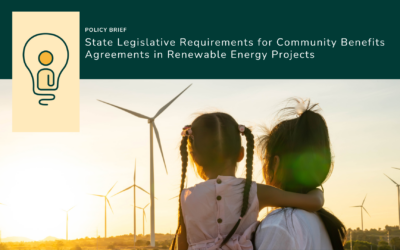
A new policy brief reveals how states use legislative requirements to ensure communities benefit from renewable energy projects.
New Report Spotlights Tools for Environmental Justice in Renewable Energy
read more
A new policy brief reveals how states use legislative requirements to ensure communities benefit from renewable energy projects.
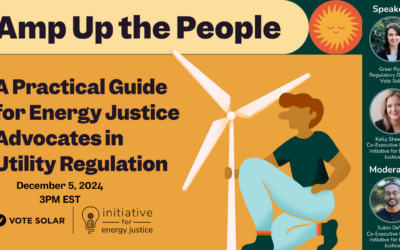
IEJ and Vote Solar examine the guide to navigate utility regulation.
Despite political shifts, energy justice progress continues locally through equitable policies and community-driven solutions.

IEJ welcomes Kelly Sheehan as Co-Executive Director, bringing 25 years of experience advancing environmental and social justice.
Co-created with Vote Solar, this guide simplifies utility regulation for energy justice advocates on the frontlines of change.
IEJ and Vote Solar’s guide gives frontline advocates the tools to influence utility regulation and advance equitable energy policies.

The J40 Initiative allocates 40% of clean energy investments to disadvantaged communities, ensuring equitable benefits.

The first federal attempt to compile environmental injustice communities was in June 1992. The J40 Initiative ensures 40% of clean energy investments for equitable benefits.
The Initiative for Energy Justice’s Justice in 100 Case Studies (Beta Version) is now available by request. Email hello@iejusa.org for a copy of the report.
This policy brief presents short- and medium-term recommendations for western states adapting to the effects of climate change. We evaluate California’s wildfire, energy, and climate change adaptation policies.